

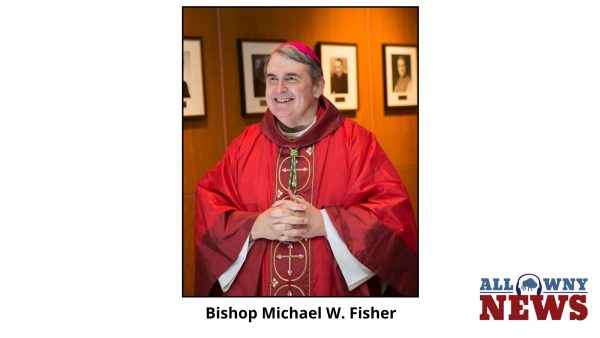
BUFFALO — In his latest Pastoral Letter, “Once Aliens, Too,” Bishop Michael W. Fisher invokes over 130 years of Catholic social teaching in a call for an end to the dehumanizing rhetoric toward immigrants and renewed respect for their inherent human dignity and basic legal protections. Bishop Fisher’s Pastoral Letter follows the recent “Special Message” issued by the United States Conference of Catholic Bishops on the same topic, and the statement of the New York Catholic Bishops issued on November 13, 2025, “For You Too Were Once Aliens…”
Bishop Fisher references the teachings of several pontiffs, beginning with the seminal 1891 papal encyclical of Pope Leo XIII, Rerum Novarum, in addition to Pius XII, Saint John Paul II, and Pope Francis, in asserting the unequivocal requirement of the Gospels and Catholic social teaching to show preference for the poor and vulnerable, and immigrants, in particular. Bishop Fisher notes how meaningful immigration reform has been “debated though delayed by both major political parties for decades.” He further reaffirms the U.S. government’s “duty to secure its borders and ensure that immigrants enter our country legally.” In doing so, however, Bishop Fisher reiterates the New York Bishop’s assertion that “The requirement to act with charity toward friend and stranger alike … takes precedence over all other imperatives. This obligation to demonstrate empathy and care for those who seek refuge in our country is ‘concerned neither with legal status nor country of origin.’”
Bishop Fisher shared his Pastoral Letter with all priests of the Diocese on Friday, prior to the First Sunday of Advent, acknowledging the “horrible tragedy that occurred in our nation’s Capital this past Wednesday, which has claimed the life of US Army Specialist Sarah Beckstrom, and critically injured US Air Force Staff Sergeant Andrew Wolfe—both members of the West Virginia National Guard.” The alleged gunman is an immigrant from Afghanistan. The Pastoral Letter is being distributed to the broader Catholic community and broader public today.
Bishop Fisher concludes his Pastoral Letter by referencing our nation’s immigrant beginnings: “Mindful that our ancestors were also once aliens in need of compassion, care, and opportunity, we must speak out for those who desire only the same, but whose voices seem not to matter, and whose basic rights—even as immigrants—are so callously cast aside. As a nation, we know in our hearts that we can and should do better. As Christians, we must.”
All WNY is made possible thanks to coffee and sleep deprivation.
We appreciate your readership. We like money, too.